Episode 1:1 -- Pilot
Okay, folks, we're going to dig right in with where it all started. In each episode post, I'll give you a breakdown of what happens in the episode in terms of plot, include what I'm calling "stray observations" about important moments or trivia, and then give an analysis of the episode. So with that being said, let's take a look at the pilot episode!
EPISODE DETAILS:
Title: Pilot
Written by: Greg Daniels and Michael Schur
Directed by: Greg Daniels
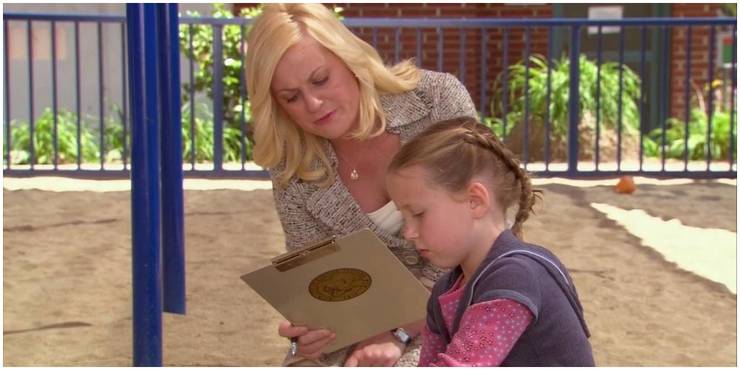
Leslie Knope as she quizzes a child about the level of fun she is experiencing in the park. While she is talking to this little girl, another child runs to her and tells her that a drunk is stuck in the slide. Leslie begins the difficult task of extracting him. This is all juxtaposed with Leslie's confessional introducing herself and espousing her belief in the power and responsibility of the government to provide services for people and make their lives better even though she also recognizes that the government has a huge image issue to overcome. She also points out that this is a powerful time for women in government, that the "old boys' club" is over thanks to powerful women like Hillary Rodham Clinton, Sarah Palin, Nancy Pelosi, and Leslie Knope herself. (Yes, she includes her own name in this list.) Eventually, she frees the drunk and confidently asserts that "Leslie Knope stops for no one" in her quest for success.
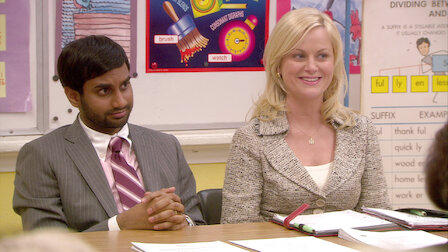
The transformation of pit to park, though, is much more challenging than it seems. Leslie knows that parks are not a priority with the city council, so she decides she needs to form a committee to coordinate the effort to create the park. She floats by Tom the idea of bringing city planner Mark Brandanowicz on board, telling us in a confessional that he's a person you go to when you need to get stuff done. Mark agrees that the pit is a huge problem, but when Leslie raises the idea of turning it into a park, Mark cautions her that it is not possible because of the oceans of red tape she would have to cut through to make it work. In a confessional, Leslie also informs us that she and Mark slept together, an event Mark barely remembers.
Leslie goes to look at the pit and brings Tom as well as their college intern April Ludgate. She also meets Andy, Ann's boyfriend who broke his legs. Leslie refers to him as a "hero" but he is clearly a bit of a slacker slug who sits on the couch playing video games and digging under his casts with his "itch stick." Leslie sees the pit and envisions the grand park she could build (much grander than the size of the lot
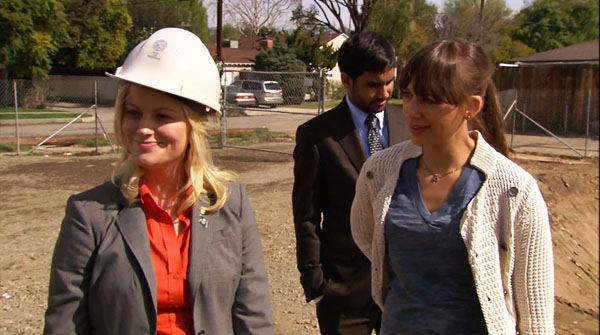
would allow). Leslie decides to climb down into the pit and quickly falls, much to the delight of Tom and April who take pictures of the whole thing.
Leslie goes to Ron Swanson to get his go-ahead for her to form her committee and pursue the building of a park, a request that seems likely to be denied when Ron reveals in a confessional that he is a strict libertarian who would rather see everything privatized for profit, including parks. Leslie continues her campaign with him, but his heels are dug in until he is visited by Mark. Mark, seemingly spurred by the pictures of Leslie's fall into the pit that Tom and April are proudly sharing, goes to Ron and asks him to give Leslie the go-ahead. He reminds Ron that he owes him one and that this is how Mark is cashing in this mysterious IOU. Mark tells us in a confessional that he lost his idealism pretty quickly into his time in government but is impressed that Leslie has yet to lose hers. Her idealism has seemingly rubbed off on him and prompted him to get involved in her project despite the many challenges he knows that lie ahead.
Leslie learns that her committee has been approved and celebrates with Ann who vows that she will do whatever it takes to help make this park happen.
In the closing tag, Ron gives us a tour of his office including the mounted sawed-off shotgun anyone coming to make a request from him has to stare down and his picture of his hero, Bobby Knight.
STRAY OBSERVATIONS
* We catch glimpses of both Donna and Jerry but neither are introduced to us nor do they have any dialogue. At this point, they are glorified extras although they are identified in the credits by name at the end. (Check out the HORRIBLE wig Donna is saddled with -- a far cry from the fashionista who will soon encourage the world to "treat yo'self."
* Our first community forum features Loudon Wainwright and Ian Roberts. Roberts is a co-founder of UCB with Poehler. A LOT of UCB people will find their way into guest appearances on this show.
* Tom reveals that he is from Bennetsville, South Carolina. Aziz Ansari is indeed a South Carolina native.
* In Leslie's office, she has framed pictures of Bella Abzug and Nancy Pelosi as well as an autographed photo of Indiana-native Larry Bird. The inscription on the picture says, "Lesly, sink that shot!" And yes, her name IS misspelled.
* It is revealed here that Leslie has been with the parks and rec department for six years. Leslie, too, tells us that she is "barely 34."
ANALYSIS
The first season of this show gets a lot of grief. While this episode functions as a fine pilot, it's also clearly trying to model itself a bit too much on The Office. You have a dysfunctional office environment where no one seems to particularly like each other (April and Tom take great delight in Leslie's tumble into the pit, and the pictures they share are as embarrassing as possible -- including an "upskirt" shot). Leslie is filled with optimism and idealism, but there is an air about her that she is also a bit of a delusional buffoon ala Michael Scott. It is also clear the writers were hoping to establish Leslie and Mark as the show's Jim and Pam as Leslie has clearly placed much more weight on their one-night stand five years ago than he has but Mark is charmed by her idealism.
It is hard to view this show without the context of what lies ahead. When I watch this episode now, all I see are the seeds planted and how they will end up blossoming so much differently than intended.
Leslie's unshakable idealism and faith in the power of government and her innate desire to help people is here from the very beginning. What's missing, though, is the strength and competence that will be a trademark of her character starting in season two. She also comes across here as a little dim -- her idealism comes across as lacking in the intelligence that is also a core part of her character in later seasons. This Leslie is more stymied by roadblocks such as the door to the auditorium where she's supposed to hold her forum being locked or the lights being turned off mid-meeting. She's likable enough but far from the icon she will become.
Watching this first episode, it's a bit hard to believe that Ron Swanson will eventually become one of the most universally adored characters on this show. It's not that Ron is that different here -- the core of his character is pretty clearly laid out and remains pretty solid. Ron is a libertarian who believes that government should not be in the business of providing services that could be handled by private industry. He is stubborn in this idea in episode one, just as he is stubborn in this idea throughout the later seasons. How this Ron differs, though, is in his heart. Pilot Ron seems a bit cold. He lacks some of the other idiosyncrasies that will eventually make him so adored, particularly his affection and respect for Leslie. Ron and Leslie's friendship lies at the core of the show, and it is not here in episode one. Ron views Leslie as a nuisance and seems less appreciative of the way she challenges him. Pilot Ron exists more as an antagonist to Leslie than a mere foil. You can envision a version of this show where Ron is the "villain" of the show and he and Leslie are constantly pitted against each other without the mutual affection and respect that marks their conflicts in later episodes.
The other significant Parks Department employee we spend some quality time with here is Tom. (April barely registers as more than a minor character so we'll save her for later in this season.) Pilot Tom is, to be honest, a total sleaze. He clearly sees his job in the government as a pathway to his own profit. We see him in this episode striking a deal for free suits and encouraging the vendor to send the suits to his wife so as to avoid ethics issues. He openly hits on Ann during the community forum. He seems to have zero respect for Leslie, showing the pictures of her fall into the pit and not writing down things she asks him to. Again, there are character traits here that are part of Tom Haverford's DNA until the end of the series, but what is missing here is Tom's heart. Tom may try to present himself as a player and a baller in later episodes, but there is a heart at his core that makes him lovable. In later episodes, his love and admiration of Leslie are clear. This Tom seems to care only about himself.

As many critics and fans of television will tell you, one of the key elements of a good pilot is creating a sort of audience surrogate to introduce the viewers to the world. Introduce a new character or outsider to a set situation and as they learn the ropes, so do we. The perfect example of this is Diane Chambers in the pitch perfect pilot of Cheers. In a way here, we sort of get two audience surrogates. The first and most obvious one in the Parks and Rec pilot is Ann Perkins. She is introduced as a complete novice, someone who flat out says she has zero interest in politics. So she becomes our gateway character, the character with whom we connect the most because she's experiencing what we're experiencing. Utilizing the mockumentary format allows this to become even more clear because Ann can speak directly to us, saying things like, "Leslie seems weird but her heart is in the right place." As Ann is drawn into this world and finding a faith and respect in Leslie, so do we. We GET Ann because we ARE Ann.

As I said above, the first season of this show is often dismissed critically. The characters are not quite there, the plots of the episodes can be a bit plodding (particularly episodes 2, 3, and 4), and Leslie can be more than a bit grating, which I'll talk about more as we look at the other episodes of this season. I often wonder, though, how much of the general dismissal of this season lies in how heavily the shadow of The Office looms over it. It is clear that the initial idea here was "The Office set in local government" and giving us the swerve of Michael Scott being a woman. The mockumentary elements feel tired and forced; the characters feel a bit stale because we've seen them before -- the inept boss, the wry hearthrob, the goodhearted cute girl with the crap boyfriend, the silent but bland co-workers in the background. Whether or not this pilot would work better had The Office not come first is, I know, a moot point because this pilot probably would not have existed period without The Office. What I can say, though, is these first six episodes are an interesting pathway to what the show will become and the seeds are planted for a show that, while never a huge hit, has become tremendously beloved and influencial in terms of re-introducing kindness to comedy. That alone makes this episode and the five episodes that join it in forming a first season worth it.


Comments
Post a Comment